<?xml version="1.0" encoding="utf-8"?><feed xmlns="http://www.w3.org/2005/Atom" xml:lang="en_US"><generator uri="https://jekyllrb.com/" version="4.4.1">Jekyll</generator><link href="https://ramezanpour.net/feed.xml" rel="self" type="application/atom+xml" /><link href="https://ramezanpour.net/" rel="alternate" type="text/html" hreflang="en_US" /><updated>2026-09-09T13:45:15+00:00</updated><id>https://ramezanpour.net/feed.xml</id><title type="html">Mohammad M. Ramezanpour</title><subtitle>Software developer since 2002, husband since 2012, and father since 2017.  Also a bookworm, math lover, physics enthusiast.</subtitle><author><name>Mohammad M. Ramezanpour</name></author><entry><title type="html">Moving is hard, but we’re happy we did it</title><link href="https://ramezanpour.net/post/2026/08/22/moving-is-hard-but-we-are-happy-we-did-it" rel="alternate" type="text/html" title="Moving is hard, but we’re happy we did it" /><published>2026-08-22T00:00:00+00:00</published><updated>2026-08-22T00:00:00+00:00</updated><id>https://ramezanpour.net/post/2026/08/22/moving-is-hard-but-we-are-happy-we-did-it</id><content type="html" xml:base="https://ramezanpour.net/post/2026/08/22/moving-is-hard-but-we-are-happy-we-did-it"><![CDATA[<p><img src="/assets/images/moving-2026.jpg" alt="Moving" /></p>

<p>Since we <a href="/post/2021/04/03/The-move">moved to Germany in March 2021</a>, we’ve changed flats three times. When we
arrived in BER airport for the first time, we rented a temporary, furnished flat for six months. Then we moved to a
permanent, unfurnished flat so that we could start personalising our living space. Five years later, we’ve moved again,
this time into a flat of our own.</p>

<p>The first two moves were relatively easy. When we arrived at BER airport, we had only four big pieces of luggage. After
six months, when we moved to the new unfurnished flat, we’d bought only a few things. Due to COVID, we were exposing
ourselves to the outside world only when necessary. This time, however, was different. We had bought a lot of different
things. We basically had everything we had before migrating to Germany, plus a lot of new stuff for Nika, our daughter.</p>

<p>It took us more than two weeks to move everything. At first, I thought I could do it myself, just like the first time.
This time was a bit different, though, because we had a car. So I decided to start taking things over bit by bit every
day after work, and for the bigger stuff, I would take an XXL <a href="https://www.miles-mobility.com" target="_blank">Miles</a>
car.</p>

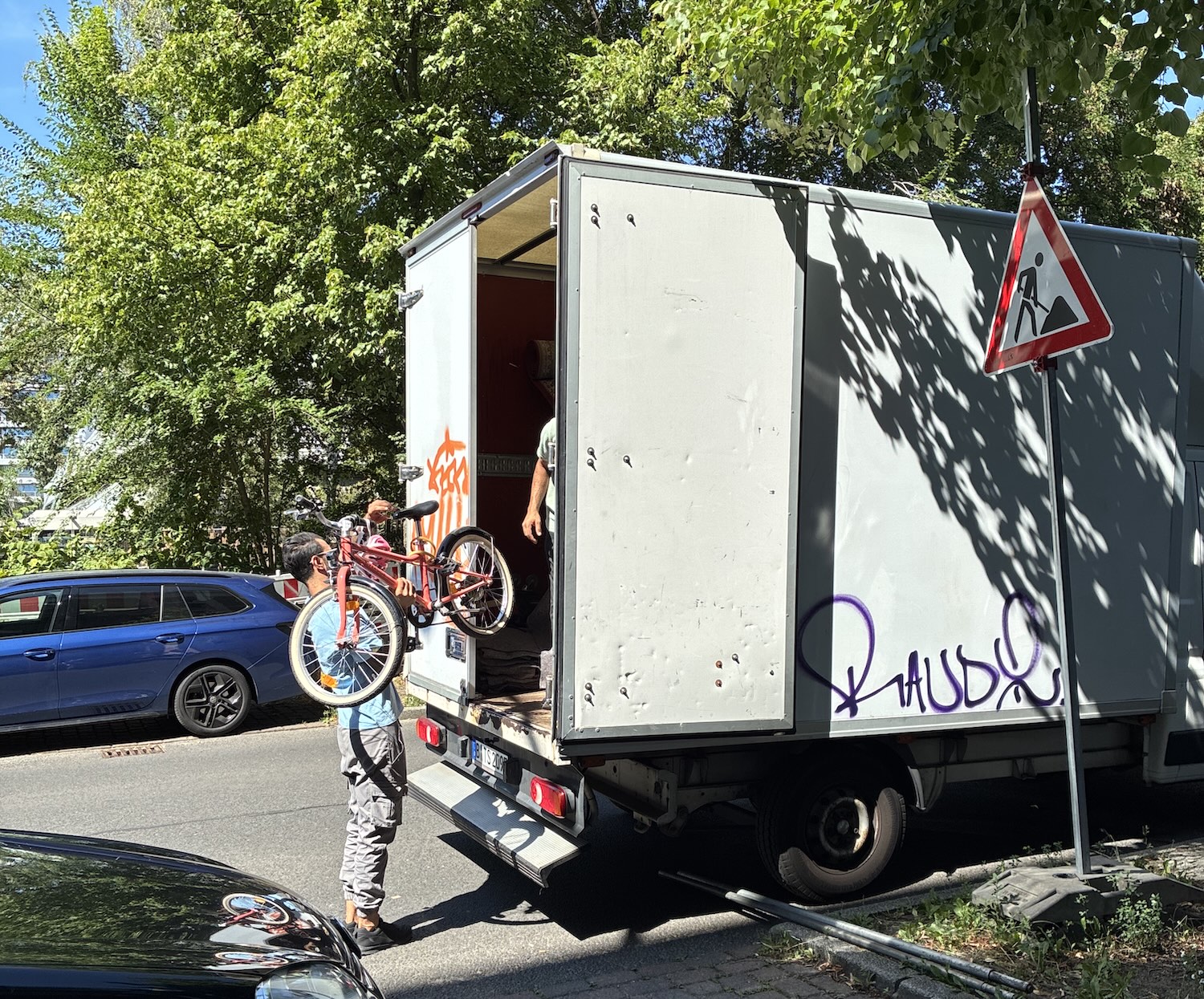
<p>After doing this for five days, I faced reality: we had much more stuff than I had expected. So, I hired one of those
moving companies that brings its own transporter to move the rest. It took them eight hours to move everything that day.</p>

<p>After we moved, I thought everything was finally finished and that I could get back to normal life. However, it was only
the beginning.</p>

<p>The flat we moved into is brand new. This is great, but it also means that we have to buy a lot of things for it. For
example, we needed new lighting for every single room. In addition, small things such as toilet paper holders and
bathroom mirrors had to be installed, and we had to find a new internet provider, among many other things.</p>

<p>As I’m writing this, we’ve been living here for two weeks, and there are still a lot of these small things that need to
be done.</p>

<h2 id="change-of-address">Change of address</h2>

<p>This is probably one of the most underrated things you need to do after relocating to a different place in Germany. You
need to change your address with almost every service you use. I knew this had to be done, so I started preparing a
list:</p>

<ul>
  <li>DHL</li>
  <li>PayPal</li>
  <li>Mobile phone service provider</li>
  <li>The company I bought my car from</li>
  <li>Liability insurance company</li>
  <li>Berufsunfähigkeitsversicherung provider</li>
  <li>Google</li>
  <li>Netflix</li>
  <li>Spotify</li>
  <li>Car insurance company</li>
  <li>Apple</li>
  <li>Deutsche Bahn</li>
  <li>Rundfunk (public radio and TV in Germany)</li>
  <li>Deutsche Bank</li>
  <li>Revolut</li>
  <li>N26</li>
  <li>IKEA</li>
  <li>Hausverwaltung (property management company)</li>
  <li>Amazon</li>
  <li>Anmeldung (official address registration in Germany)</li>
  <li>Car registration</li>
  <li>The company I work for</li>
  <li>Miles</li>
  <li>Health insurance company</li>
  <li>The company I buy my domains from</li>
</ul>

<p>The funny thing is that while writing this list, a few new items came to mind that I had to add to it.</p>

<h2 id="handing-over-the-previous-flat">Handing over the previous flat</h2>

<p>If you’re single or a couple without children, this part should be relatively straightforward. With kids, however, it’s
a bit different.</p>

<p>When we moved into our previous flat, Nika was only 3.5 years old. She’s now nine. In Germany, you’re generally expected
to return a rented flat in the condition in which you received it. This can include things such as walls and painting.</p>

<p>There were a lot of small spots that we had to clean up in almost every room. We’ve already fixed many of them, but as
I’m writing this, there are still a lot of things that need to be done.</p>

<p>One easy option is to hire a painter to do it for you, but obviously, that costs a lot of money. For our 76sqm flat, we
were quoted around €1,000 by a painter to do the work. The wall paint and all the equipment we needed cost less than
€100. As a result, we decided to do it ourselves.</p>

<p>We’re hoping that once we’ve fixed everything, we’ll be able to get our deposit back in full. There are a lot of stories
on the internet about landlords charging their tenants for every small thing, so it makes us a bit worried.</p>

<h2 id="but-were-super-happy-about-it">But we’re super happy about it</h2>

<p>Everything I’ve mentioned above is about the pain points and the ton of work we had to do. Honestly, my body aches as
I’m writing this because of all the work. But I think it’s important to mention that we’re super happy with the final
result.</p>

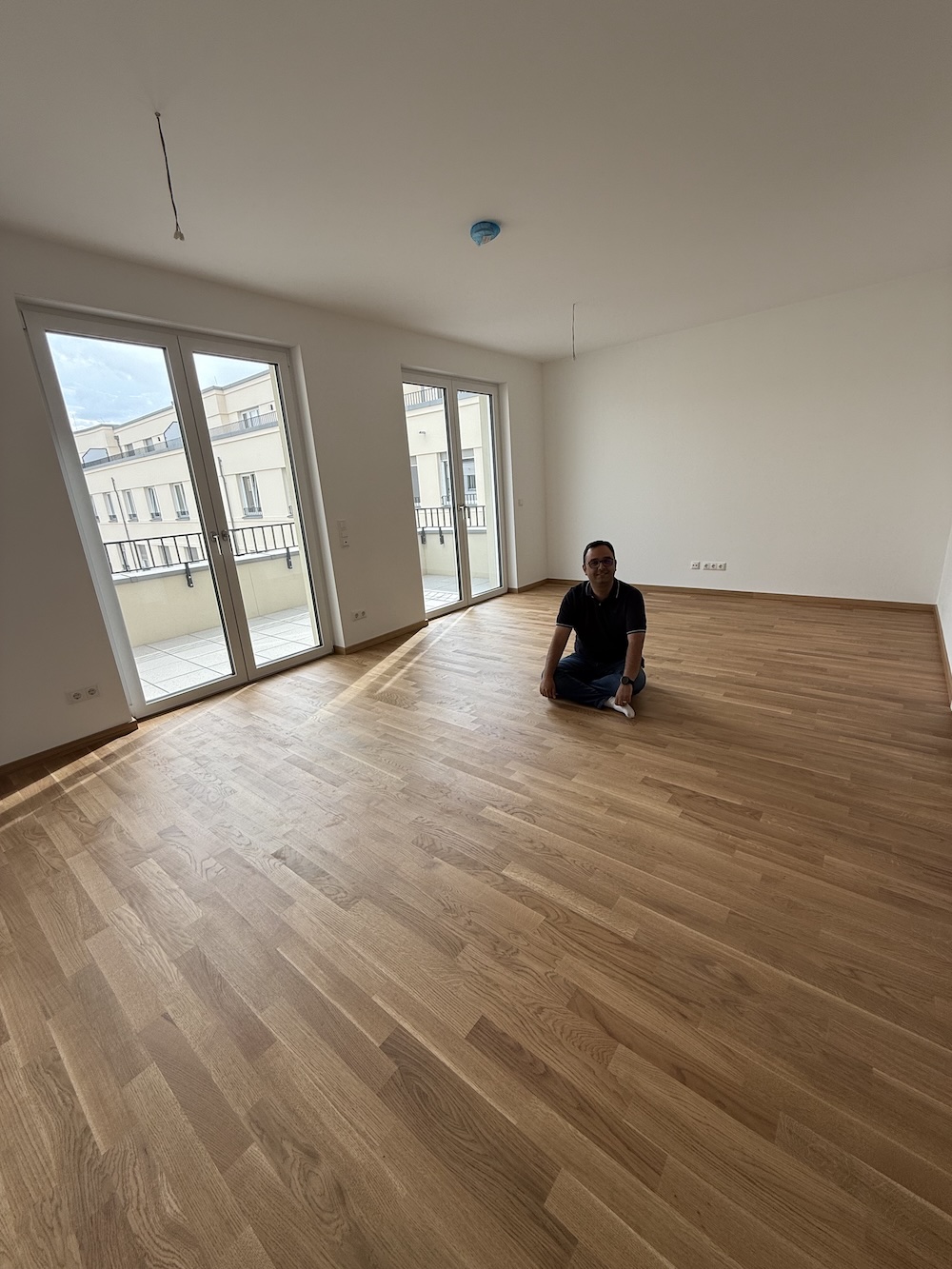
<p><img src="/assets/images/me_sitting_in_our_empty_flat.jpeg" alt="Me sitting in our flat as we received it" /></p>

<p>First of all, we’re moving into a home of our own. We still make a monthly payment, but now it’s to the bank rather than
to a landlord. Every mortgage payment is, at least in part, an investment in something that belongs to us.</p>

<p>Second, the flat we’ve moved into has three bedrooms instead of one. Given that we have only one child, one of the rooms
can be used as a home office and gym. This gives us a lot more flexibility and convenience.</p>

<p>After a lot of work and effort, we’ve finally reached our sweet spot. And I think this is, in many ways, what life is
about.</p>

<p>The things that matter most rarely come easily. They require time, effort, frustration, and sometimes a lot of physical
pain. But when you finally get there, you look back and realise that all that effort was worth it.</p>]]></content><author><name>Mohammad M. Ramezanpour</name></author><summary type="html"><![CDATA[Moving into our own home turned out to be much harder than expected—from carrying boxes and changing addresses to fixing our old flat. But after all the work, we couldn't be happier.]]></summary><media:thumbnail xmlns:media="http://search.yahoo.com/mrss/" url="https://ramezanpour.net/assets/images/moving-2026.jpg" /><media:content medium="image" url="https://ramezanpour.net/assets/images/moving-2026.jpg" xmlns:media="http://search.yahoo.com/mrss/" /></entry><entry><title type="html">How to calculate how much memory Google Chrome actually uses</title><link href="https://ramezanpour.net/post/2026/08/06/how-to-calculate-how-much-memory-google-chrome-actually-uses" rel="alternate" type="text/html" title="How to calculate how much memory Google Chrome actually uses" /><published>2026-08-06T00:00:00+00:00</published><updated>2026-08-06T00:00:00+00:00</updated><id>https://ramezanpour.net/post/2026/08/06/how-to-calculate-how-much-memory-google-chrome-actually-uses</id><content type="html" xml:base="https://ramezanpour.net/post/2026/08/06/how-to-calculate-how-much-memory-google-chrome-actually-uses"><![CDATA[<p>Google Chrome is the most popular browser in the world according to recent statistics. It’s also well known for
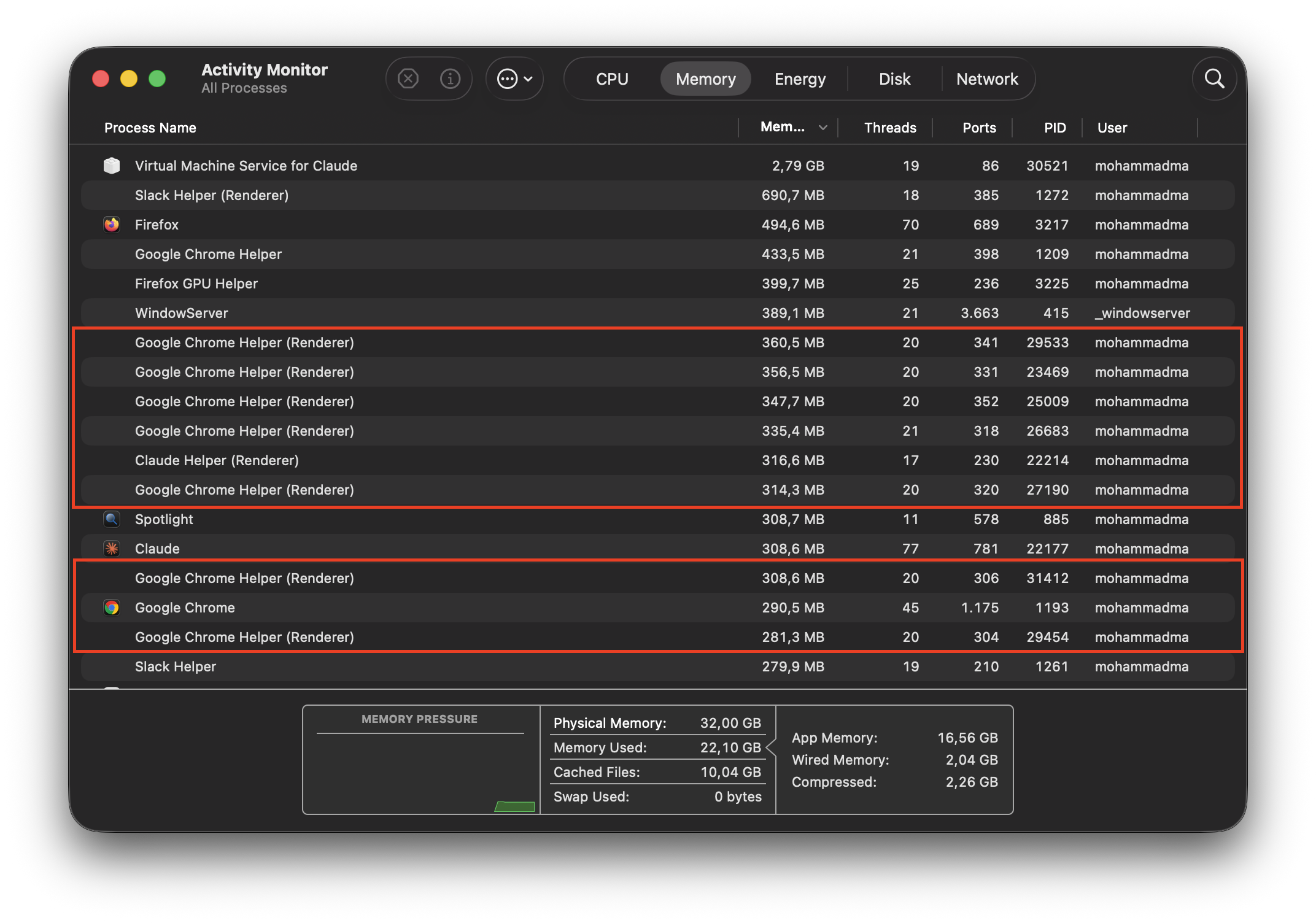
consuming a significant amount of memory. The other day, I became curious about how much memory Chrome was actually
using. When I opened Activity Monitor (or <a href="https://en.wikipedia.org/wiki/Htop"><code class="language-plaintext highlighter-rouge">htop</code></a>), I saw something like this:</p>

<p><img src="/assets/images/chrome_activity_monitor.png" alt="Chrome usage in Activity Monitor" /></p>

<p>With only six tabs open, there were already more than twenty Chrome-related processes running on my machine. That made
me wonder: <em>How much memory is Chrome actually using?</em> So I decided to write a small shell script to calculate the total
memory usage of all Chrome processes.</p>

<blockquote>
  <p><strong>Note:</strong> This script sums the <strong>RSS (Resident Set Size)</strong> of all Chrome processes. RSS is a useful approximation of
an application’s memory footprint, but it is not a perfect representation of the total memory used because some memory
pages are shared between processes.</p>
</blockquote>

<h2 id="the-script">The script</h2>

<p>Although tools such as macOS Activity Monitor and the popular <code class="language-plaintext highlighter-rouge">htop</code> make it easy to inspect running processes,
Unix-like operating systems also provide a powerful built-in utility called
<a href="https://en.wikipedia.org/wiki/Ps_(Unix)"><code class="language-plaintext highlighter-rouge">ps</code></a>.</p>

<p>If you run <code class="language-plaintext highlighter-rouge">ps</code> without any additional arguments, it shows a snapshot of the processes associated with your current
terminal session. However, running <code class="language-plaintext highlighter-rouge">man ps</code> quickly reveals just how powerful this tiny utility really is. You can
customise almost every aspect of its output, including which columns are displayed. That’s exactly what we’ll take
advantage of.</p>

<p>The first thing we need is a list of every running process on the machine, not just those belonging to the current
terminal session. We can achieve this with the <code class="language-plaintext highlighter-rouge">-e</code> option. Since we also need specific columns instead of the default
output, we’ll use <code class="language-plaintext highlighter-rouge">-o</code> to specify the fields we want:</p>

<div class="language-sh highlighter-rouge"><div class="highlight"><pre class="highlight"><code>ps <span class="nt">-eo</span> pid,rss,comm,args
</code></pre></div></div>

<p>Next, we need to filter the list to only include Chrome-related processes. To keep things simple, we’ll search for the
word <code class="language-plaintext highlighter-rouge">chrome</code>. Nothing beats <code class="language-plaintext highlighter-rouge">grep</code> when it comes to searching text from the command line:</p>

<div class="language-sh highlighter-rouge"><div class="highlight"><pre class="highlight"><code>ps <span class="nt">-eo</span> pid,rss,comm,args | <span class="nb">grep</span> <span class="nt">-iE</span> <span class="s2">"chrome"</span>
</code></pre></div></div>

<p>There’s one small issue, though. Since we’re using <code class="language-plaintext highlighter-rouge">grep</code> to search for <code class="language-plaintext highlighter-rouge">chrome</code>, the <code class="language-plaintext highlighter-rouge">grep</code> process itself also appears
in the results:</p>

<pre><code class="language-txt">45801   1376 grep             grep --color=auto --exclude-dir=.bzr --exclude-dir=CVS --exclude-dir=.git --exclude-dir=.hg --exclude-dir=.svn --exclude-dir=.idea --exclude-dir=.tox --exclude-dir=.venv --exclude-dir=venv -iE chrome
</code></pre>

<p>A common Unix idiom is to filter that line out using another <code class="language-plaintext highlighter-rouge">grep</code>:</p>

<div class="language-sh highlighter-rouge"><div class="highlight"><pre class="highlight"><code>ps <span class="nt">-eo</span> pid,rss,comm,args | <span class="nb">grep</span> <span class="nt">-iE</span> <span class="s2">"chrome"</span> | <span class="nb">grep</span> <span class="nt">-v</span> <span class="nb">grep</span>
</code></pre></div></div>

<p>Now we have a list of all Chrome-related processes. The only thing left is to sum their RSS values (reported in KB).</p>

<p>There are many ways to process the output, extract the RSS values, and calculate their sum. To keep everything within a
shell script, I decided to use <a href="https://en.wikipedia.org/wiki/AWK"><code class="language-plaintext highlighter-rouge">awk</code></a>, a small but incredibly powerful
text-processing language.</p>

<p>The AWK is “a scripting language designed for text processing and typically used as a data extraction and reporting
tool”. It reads input one line at a time, automatically splits each line into space-separated fields ($1, $2, $3, …),
and lets you run code against those fields.</p>

<p>Since the RSS value is the second column in our <code class="language-plaintext highlighter-rouge">ps</code> output, we need <code class="language-plaintext highlighter-rouge">$2</code>. I also wanted to know how many Chrome
processes were running, so I kept track of both the total memory (<code class="language-plaintext highlighter-rouge">sum</code>) and the number of processes (<code class="language-plaintext highlighter-rouge">count</code>). Finally,
I converted the total from KB into MB and GB to make the output easier to read.</p>

<div class="language-sh highlighter-rouge"><div class="highlight"><pre class="highlight"><code><span class="nb">awk</span> <span class="s1">'
{
    sum += $2
    count++
}
END {
    if (count == 0) {
        print "No Chrome processes found."
        exit 1
    }

    printf "Chrome processes found: %d\n", count
    printf "Total RSS memory: %d KB (%.2f MB / %.2f GB)\n", sum, sum/1024, sum/1024/1024
}'</span>
</code></pre></div></div>

<p>Now we have everything we need. Let’s put the pieces together:</p>

<div class="language-sh highlighter-rouge"><div class="highlight"><pre class="highlight"><code><span class="c">#!/bin/bash</span>

ps <span class="nt">-eo</span> pid,rss,comm,args | <span class="nb">grep</span> <span class="nt">-iE</span> <span class="s2">"chrome"</span> | <span class="nb">grep</span> <span class="nt">-v</span> <span class="nb">grep</span> | <span class="nb">awk</span> <span class="s1">'
{
    sum += $2
    count++
}
END {
    if (count == 0) {
        print "No Chrome processes found."
        exit 1
    }

    printf "Chrome processes found: %d\n", count
    printf "Total RSS memory: %d KB (%.2f MB / %.2f GB)\n", sum, sum/1024, sum/1024/1024
}'</span>
</code></pre></div></div>

<p>Running the script produces output similar to the following:</p>

<pre><code class="language-txt">Chrome processes found: 34
Total RSS memory: 7191920 KB (7023.36 MB / 6.86 GB)
</code></pre>

<p>I found the results surprisingly interesting. During one of my meetings, Chrome’s RSS memory usage climbed to almost <strong>9
GB</strong>, which I wasn’t expecting. It was also surprising to see that Chrome had more than <strong>30 processes</strong> running at the
same time.</p>

<p>If you’re curious about your own numbers, simply copy the script above into a file—for example,
<code class="language-plaintext highlighter-rouge">chrome_processes.sh</code>—make it executable, and run it:</p>

<div class="language-sh highlighter-rouge"><div class="highlight"><pre class="highlight"><code><span class="nb">chmod</span> +x chrome_processes.sh
./chrome_processes.sh
</code></pre></div></div>

<p>I’m curious to know what numbers you get. Feel free to let me know in the comments.</p>]]></content><author><name>Mohammad M. Ramezanpour</name></author><category term="musing" /><summary type="html"><![CDATA[Learn how to calculate Google Chrome's total memory usage by summing the RSS of all its processes using ps, grep, and awk on macOS and Linux.]]></summary><media:thumbnail xmlns:media="http://search.yahoo.com/mrss/" url="https://ramezanpour.net/assets/images/chrome_activity_monitor.png" /><media:content medium="image" url="https://ramezanpour.net/assets/images/chrome_activity_monitor.png" xmlns:media="http://search.yahoo.com/mrss/" /></entry><entry><title type="html">Productive Procrastination</title><link href="https://ramezanpour.net/post/2026/08/01/new-forms-of-procastination" rel="alternate" type="text/html" title="Productive Procrastination" /><published>2026-08-01T00:00:00+00:00</published><updated>2026-08-01T00:00:00+00:00</updated><id>https://ramezanpour.net/post/2026/08/01/new-forms-of-procastination</id><content type="html" xml:base="https://ramezanpour.net/post/2026/08/01/new-forms-of-procastination"><![CDATA[<p><img src="/assets/images/procrastination_by_reading.jpg" alt="Procrastination by reading" /></p>

<p>Sometimes procrastination doesn’t look like procrastination at all. It can disguise itself as something productive or
even self-improvement. Here are a few examples:</p>

<ul>
  <li>Continuing your education when you know you won’t benefit from it or use it. For example, you already have a BS or MS
degree, your career is going well, but you have spare time and money and don’t know what to do with them.</li>
  <li>Writing RFCs for small features where the implementation would take less time than writing the RFC itself.</li>
  <li>Scheduling meetings for next week when the discussion could easily happen asynchronously.</li>
  <li>Buying additional devices or gadgets because you believe they’ll make you more productive, when in reality they only
add more distractions.</li>
  <li>Reading books. Yes, even reading can become procrastination if you’re reading just to avoid doing the work that
actually matters.</li>
  <li>Attending random conferences and meetups without a clear purpose.</li>
  <li>Organising your notes or TODO list for the fifth time instead of starting the task.</li>
  <li>Switching from one LLM to another, even though any of them could answer 90% of your questions.</li>
  <li>Thinking about how to stop procrastinating instead of doing the thing you’ve been avoiding.</li>
</ul>

<p>To me, the activity itself isn’t the problem. Learning, reading, writing, and networking are all valuable things. But I
sometimes notice they become a form of procrastination when I use them to avoid something more important, difficult, or
uncomfortable.</p>

<p>That reminds me of a quote I once heard:</p>

<blockquote>
  <p>Procrastination isn’t always avoiding work. Sometimes it’s choosing work that feels safer.</p>
</blockquote>]]></content><author><name>Mohammad M. Ramezanpour</name></author><category term="thoughts" /><summary type="html"><![CDATA[Procrastination can disguise itself as productivity, from endless RFCs to needless meetings. How to spot productive procrastination.]]></summary><media:thumbnail xmlns:media="http://search.yahoo.com/mrss/" url="https://ramezanpour.net/assets/images/procrastination_by_reading.jpg" /><media:content medium="image" url="https://ramezanpour.net/assets/images/procrastination_by_reading.jpg" xmlns:media="http://search.yahoo.com/mrss/" /></entry><entry><title type="html">I’m not sure if I’m chatting with humans anymore</title><link href="https://ramezanpour.net/post/2026/07/24/i-am-not-sure-if-chatting-with-a-human-anymore" rel="alternate" type="text/html" title="I’m not sure if I’m chatting with humans anymore" /><published>2026-07-24T00:00:00+00:00</published><updated>2026-07-24T00:00:00+00:00</updated><id>https://ramezanpour.net/post/2026/07/24/i-am-not-sure-if-chatting-with-a-human-anymore</id><content type="html" xml:base="https://ramezanpour.net/post/2026/07/24/i-am-not-sure-if-chatting-with-a-human-anymore"><![CDATA[<p><img src="/assets/images/interaction-with-robot.jpg" alt="Interaction with a robot" /> <em><small>Photo by <em><small>Photo by
<a href="https://unsplash.com/@katjaano?utm_source=unsplash&amp;utm_medium=referral&amp;utm_content=creditCopyText">Katja
Ano</a> on
<a href="https://unsplash.com/photos/a-person-holding-a-robotic-hand-in-front-of-a-mirror-_7ceGXTAtyQ?utm_source=unsplash&amp;utm_medium=referral&amp;utm_content=creditCopyText">Unsplash</a></small></em></small></em></p>

<p>Since the beginning of the year, the use of LLMs has increased significantly, not only in coding and software
engineering but also in product management, consulting, and many other fields. From LLMs to agents to specialised AI
skills, the technology is evolving at an incredible pace.</p>

<p>Unlike some people who worry that AI will take their jobs, I believe we should embrace these tools and use them to
improve the quality of our work and our lives. AI has become an invaluable assistant, and I wouldn’t want to work
without it anymore.</p>

<p>However, there is one area where I don’t want to rely on AI: human interactions.</p>

<p>The reason I’m bringing this up is because of a situation I’m currently facing with one of my colleagues. They work in a
different department, and for the past four months, every Slack message they’ve sent me has ended with a “Sent with
Claude” tag.</p>

<p>I’ve met them in person many times, and we’ve had plenty of authentic conversations in the office. They’re thoughtful,
friendly, and easy to talk to. But our <em>asynchronous</em> conversations feel completely different. They no longer sound like
the person I know.</p>

<p>The issue isn’t that they’re using Claude. I use AI every day myself. The issue is that I no longer know whether I’m
reading their thoughts or an AI-generated response. Over time, it starts to feel less like a conversation between two
people and more like an exchange between two assistants.</p>

<p>I believe AI should help us think, create, and get things done faster while producing higher-quality work. But when it
comes to communicating with other people, I think we should establish sensible guardrails. Not every message has to be
perfectly polished. Sometimes the imperfections, the writing style, and the personality behind a message are exactly
what make it human.</p>

<p>Perhaps this is the future of work, and I’ll eventually get used to it. But today, I still value knowing that there’s a
real person on the other side of the conversation.</p>]]></content><author><name>Mohammad M. Ramezanpour</name></author><category term="thoughts" /><summary type="html"><![CDATA[As LLMs spread across coding, product, and consulting, I explore the unsettling feeling of no longer knowing if I'm talking to a human.]]></summary><media:thumbnail xmlns:media="http://search.yahoo.com/mrss/" url="https://ramezanpour.net/assets/images/interaction-with-robot.jpg" /><media:content medium="image" url="https://ramezanpour.net/assets/images/interaction-with-robot.jpg" xmlns:media="http://search.yahoo.com/mrss/" /></entry><entry><title type="html">What 40 Days Without Dopamine Taught Me</title><link href="https://ramezanpour.net/post/2026/01/10/dopamine-detox-results" rel="alternate" type="text/html" title="What 40 Days Without Dopamine Taught Me" /><published>2026-01-10T00:00:00+00:00</published><updated>2026-01-10T00:00:00+00:00</updated><id>https://ramezanpour.net/post/2026/01/10/dopamine-detox-results</id><content type="html" xml:base="https://ramezanpour.net/post/2026/01/10/dopamine-detox-results"><![CDATA[<p><img src="/assets/images/freedom-from-detox.jpg" alt="Freedom from Detox" /> <em><small>Photo by
<a href="https://unsplash.com/@grantritchie?utm_source=unsplash&amp;utm_medium=referral&amp;utm_content=creditCopyText">Grant
Ritchie</a> on
<a href="https://unsplash.com/photos/silhouette-of-person-on-rock-Jd2fqoX3z_0?utm_source=unsplash&amp;utm_medium=referral&amp;utm_content=creditCopyText">Unsplash</a></small></em></p>

<p>During December 2025, I voluntarily started a detox challenge that I called <a href="/post/2025/12/03/dopamine-detox-december">Dopamine Detox
December</a>. For the entire month of December, I stopped:</p>

<ul>
  <li>Using social media of any kind (including platforms that some people don’t count as social media, such as LinkedIn)</li>
  <li>Consuming news. I asked my wife to let me know if there was any urgent news I needed to know about.</li>
  <li>Using video streaming services such as Netflix or Amazon Prime<br />
(I was still watching movies with my family, but we knew exactly which movie we wanted to watch and when.)</li>
  <li>Playing video games of any kind</li>
</ul>

<p>Contrary to what I was expecting, quitting social media was not the most difficult part. After about a week, everything
felt normal, almost as if social media had never existed. That said, the first five days were <em>very</em> difficult.</p>

<p>I was also not a heavy consumer of video streaming services, so quitting them was relatively easy. Given that we were
already watching movies only on Sunday afternoons, I barely felt their absence.</p>

<p>Avoiding news, however, was very challenging for me. Given everything that is happening in my country, it sometimes
feels like destiny for Persians to be tied to news websites. Despite this, I tried very hard to “change the subject”
every time my mind urged me to check the news.</p>

<p>Whenever I felt that urge, I went for a walk. This helped a lot, but it wasn’t enough on its own. What helped the most
were my conversations with my wife during breakfast. Every day, she would tell me what had happened the day before. Some
days there was complete silence and we talked about something else; on other days, it was all about politics.</p>

<h2 id="the-most-difficult-habit-to-quit">The most difficult habit to quit</h2>

<p>I never thought video games would be this difficult to quit. I never considered myself dependent on games — I was
playing maybe an hour a day. But what I realised during this detox was that video games produced the strongest dopamine
stimulation for me.</p>

<p>Even now, I sometimes feel the urge to play something when I get stressed or bored. To create a barrier, I uninstalled
all the games I was playing from my gaming console so that reinstalling them would take at least 30 minutes.</p>

<p>The type of game I was playing also played an important role. Games like
<a href="https://en.wikipedia.org/wiki/Anno_(video_game_series)">ANNO</a> are extremely addictive. So addictive, in fact, that
there is a built-in mechanism that notifies the player to take a break every two hours.</p>

<p>Why is that? Because these games are endless. There is no real mission, and there is always something to improve. They
give you control over building a city exactly the way you want, and when it comes to that, the possibilities are
practically unlimited.</p>

<p>Besides willpower, deleting the games from my console helped a lot.</p>

<h2 id="what-really-helped-during-my-detox-period">What really helped during my detox period?</h2>

<p>Reading books and walking helped me the most during this period.</p>

<p>Reading is especially powerful because it releases dopamine <em>slowly</em> but steadily. I placed the book I was reading next
to me instead of my phone, and I put my phone in a different room the moment I arrived home.</p>

<p>I already liked reading before the challenge, but during the detox month I managed to finish four books. My screen time
before the detox wasn’t very high — around two and a half hours a day — but redirecting even two extra hours towards
reading made a significant difference. I turned time I was essentially wasting into self-improvement.</p>

<p>Walking was another big help. Every day after work, I went for a 30-minute fast walk. Sometimes I went for a run, but
during December, Berlin’s weather isn’t ideal for running, so I replaced it with walking.</p>

<p>It was important that during these walks I didn’t listen to anything. I often see people walking while listening to
music or audiobooks. That’s not a bad thing, but the purpose of these walks was different: to reset my mind from work
mode into family mode.</p>

<p>The brain needs time to “<a href="https://en.wikipedia.org/wiki/Defragmentation">defrag</a>” what happened during the day and put
things in the right place — similar to what happens during sleep. During sleep, our brain organises the information it
needs to remember and throws away what it doesn’t need.</p>

<h2 id="my-learnings">My learnings</h2>

<p>During December, I realised that I don’t need to know about other people’s lives through social media. I can live a
happy life without binding myself to TV shows and endless YouTube videos. That’s exactly how people lived for millions
of years. Streaming services are relatively recent inventions, yet suddenly we act as if we can’t live without them.</p>

<p>I also realised that human life depends on social interaction — but not through social media. It depends on real,
meaningful communication. By “in-person”, I don’t necessarily mean meeting physically. Video calls can provide a similar
level of satisfaction. For example, I noticed that I feel much better sending and receiving voice messages than text
messages. Voice carries emotion in a way text doesn’t. Over the years, we’ve tried to compensate for that with emojis,
but hearing someone’s voice — especially that of a loved one — is different.</p>

<p>Bad habits <em>can</em> be changed, even when they turn into addictions. There is usually a period during which we simply need
to tolerate discomfort and wait. After that, things improve exponentially. What matters most is replacing bad habits
with better ones.</p>

<p>Another important lesson for me was learning to deal with boredom. We should allow ourselves to be bored from time to
time. In the past, there were moments when we had nothing to do — and we simply did nothing. That was normal. Today,
there seems to be constant pressure to always be doing something. Doing nothing is often seen as being unproductive, but
that’s wrong. We should give our brains time to catch up and our bodies time to relax.</p>

<p>Humans evolved to move, explore, and search for food — not to sit and stare at phones. For millions of years, we had no
TVs, smartphones, or tablets, and many of humanity’s most important inventions came from those quieter times. When
Newton was sitting under the apple tree, he wasn’t checking Instagram or X. Otherwise, he probably wouldn’t have
discovered the <a href="https://en.wikipedia.org/wiki/Newton%27s_law_of_universal_gravitation">law of gravity</a>. Great ideas
often come from boredom. It’s perfectly fine to sit in silence and do nothing — and doing so doesn’t mean you’re falling
behind.</p>

<p>Probably the most important thing I realised during this challenge was how much healthier I felt overall — not just
mentally, but physically as well. My resting heart rate improved, and my sleep schedule normalised. Without social media
or <a href="https://de.wikipedia.org/wiki/EA_Sports_FC_26">FC 2026</a> before bed, my evenings slowed down. I was reading instead,
and after about an hour my eyes would naturally get tired. Falling asleep no longer felt like a struggle. This change
carried over into my work too. I stopped skimming Slack messages and RFCs. With a single focused read, I could actually
comprehend what I was reading.</p>

<p>Nothing dramatic changed overnight. I didn’t suddenly become more productive or happier every single day. But life
became quieter, more intentional, and more present — and that turned out to be enough.</p>]]></content><author><name>Mohammad M. Ramezanpour</name></author><category term="productivity" /><category term="life" /><summary type="html"><![CDATA[What 40 days without social media, news, streaming, and video games taught me: the surprising results of my dopamine detox.]]></summary><media:thumbnail xmlns:media="http://search.yahoo.com/mrss/" url="https://ramezanpour.net/assets/images/freedom-from-detox.jpg" /><media:content medium="image" url="https://ramezanpour.net/assets/images/freedom-from-detox.jpg" xmlns:media="http://search.yahoo.com/mrss/" /></entry><entry><title type="html">2025</title><link href="https://ramezanpour.net/post/2025/12/29/the-2025-reflection" rel="alternate" type="text/html" title="2025" /><published>2025-12-29T00:00:00+00:00</published><updated>2025-12-29T00:00:00+00:00</updated><id>https://ramezanpour.net/post/2025/12/29/the-2025-reflection</id><content type="html" xml:base="https://ramezanpour.net/post/2025/12/29/the-2025-reflection"><![CDATA[<p><img src="/assets/images/2025.jpg" alt="2025" /> <em><small> Photo by
<a href="https://unsplash.com/@kellysikkema?utm_source=unsplash&amp;utm_medium=referral&amp;utm_content=creditCopyText">Kelly
Sikkema</a> on
<a href="https://unsplash.com/photos/a-persons-hand-holding-the-number-twenty-twenty-twenty-twenty-twenty-twenty-twenty-twenty-Y2pzmNYinu0?utm_source=unsplash&amp;utm_medium=referral&amp;utm_content=creditCopyText">Unsplash</a>
</small></em></p>

<p>2026 is just around the corner. Looking back at 2025, it was a year of big changes for me. Having moved to Germany
almost five years ago, I finally felt more integrated. We tried to become part of society, learn the German language,
make German friends, and—most importantly—not remain neutral.</p>

<p>That last part matters a lot to me. I don’t like being passive. When I live in a society, I want to contribute to it. I
tried. I wasn’t successful all the time, but at least I did what I could.</p>

<p>2025 was a year of mixed feelings. On the one hand, I became more independent—both at work and in my personal life. On
the other hand, being on my own was tough. I had to make decisions without the support I previously relied on. I took on
responsibilities that, from the outside, looked scary. I committed to things I wouldn’t have committed to before.</p>

<p>I put a lot of pressure on myself this past year. Toward the end of it, I realized something important: when I give
priority to too many things, nothing gets the <em>actual</em> priority it deserves. In other words, <a href="/post/2025/12/16/when-everything-is-important-nothing-is">when everything is
important, nothing matters</a>.</p>

<p>Instead of constantly trying to achieve more, I’m learning to focus on what I already have. In 2026, I want to focus on
things that are actually important—especially those I can influence—rather than spending energy on topics I have no
control over. Basically, <a href="/post/2025/11/22/worry-about-things-you-can-change">to worry about things I can have influence
on</a>.</p>

<p>2026 is going to be exciting, and I want to embrace it. We can’t say for sure what the future holds, but we <em>can</em> say
that our actions play an important role in shaping it.</p>]]></content><author><name>Mohammad M. Ramezanpour</name></author><category term="life" /><summary type="html"><![CDATA[Looking back on 2025: a year of big changes, deeper integration in Germany, and mixed feelings about growth and belonging.]]></summary><media:thumbnail xmlns:media="http://search.yahoo.com/mrss/" url="https://ramezanpour.net/assets/images/2025.jpg" /><media:content medium="image" url="https://ramezanpour.net/assets/images/2025.jpg" xmlns:media="http://search.yahoo.com/mrss/" /></entry><entry><title type="html">When Everything Is Important, Nothing Matters</title><link href="https://ramezanpour.net/post/2025/12/16/when-everything-is-important-nothing-is" rel="alternate" type="text/html" title="When Everything Is Important, Nothing Matters" /><published>2025-12-16T00:00:00+00:00</published><updated>2025-12-16T00:00:00+00:00</updated><id>https://ramezanpour.net/post/2025/12/16/when-everything-is-important-nothing-is</id><content type="html" xml:base="https://ramezanpour.net/post/2025/12/16/when-everything-is-important-nothing-is"><![CDATA[<p>As we approach the end of the year, many people start thinking about their next steps for 2026. There are so many things
we would like to accomplish in a single year—often things that usually take a lifetime. But why is that?</p>

<p>Every year, it seems we want to do more. However, when we look at the results, most people don’t actually achieve the
long lists of goals they set. If you don’t believe me, just visit your local gym during the first week of January and
then again in July. At the beginning of the year, everyone is motivated to adopt a healthier lifestyle. A few months
later, that motivation has faded, and most people have stopped showing up.</p>

<p>Of course, there are many reasons why motivation fades. But I believe one of the main reasons is <strong>committing to too
many things at once</strong>, without realistically considering our capacity. For example, in 2023 my plan looked something
like this:</p>

<ul>
  <li>Get the B1 German certificate</li>
  <li>Get a driving license</li>
  <li>Invest in real estate</li>
  <li>Run a half-marathon</li>
  <li>Get in shape and go to the gym three times a week</li>
  <li>Excel at my job</li>
  <li>Read at least 12 books</li>
  <li>Travel twice</li>
  <li>Get a work-related certification</li>
  <li>Spend time with family and friends while doing all of the above</li>
</ul>

<p>Looking at this list now, it’s clearly ambitious—and also unrealistic. By the end of the year, I had achieved only
<em>three</em> of these goals, and most of the remaining items were pushed into the next year. More importantly, the sheer
number of commitments put me under constant stress. As the year went on, I found myself blaming myself more and more for
“failing” to keep up.</p>

<p><img src="/assets/images/burnedout.jpg" alt="burnedout" /></p>

<p><em><small>Photo by Tara Winstead on
<a href="https://www.pexels.com/photo/crumpled-papers-beside-a-laptop-8386575/">Pexels</a></small></em></p>

<p>We need to accept a simple reality: as humans, we have limited time and limited capacity. We all have 24 hours in a day.
On average, we need about 8 hours of sleep. We might convince ourselves that 6 hours is enough, but that’s rarely
sustainable and often leads to burnout. Most of us also have jobs that require 8–9 hours a day.</p>

<p>That leaves roughly 7–8 hours. If we spend around 2 hours eating and spending time with family, we are left with at most
5–6 hours per day. Over a week, that’s about 35 hours—including weekends. Excluding weekends, it’s closer to 25 hours.</p>

<p>Now consider just one goal from the list: <em>running a half-marathon</em>. Depending on your fitness level, you’ll need to run
at least three times per week. Each session easily takes 1.5 hours when you include preparation and recovery. And
running is relatively simple—you can just change clothes and go outside. If you replace that with going to the gym, you
also need to account for commute time.</p>

<blockquote>
  <p>“When everything is important, nothing is. When you have many priorities, you effectively have none.”</p>
</blockquote>

<p>Having many priorities is the same as having no priorities at all. A priority implies focus. But if you have ten things
to focus on and only a few hours per day, you end up spending 20–30 minutes on each—far too little to make meaningful
progress on any of them.</p>

<p>What I’ve learned is that it’s still useful to start with a long list like the one above. But after writing it down, we
should ruthlessly review it and reduce it to <strong>at most three priorities</strong>. Having too much on our plate doesn’t motivate
us—it overwhelms us. Over time, that pressure can quietly turn into stress, self-blame, and eventually burnout.</p>

<p>A useful question I now ask myself is: If I could only make real progress on one or two things this year, which ones
would truly matter? Everything else can wait—and that’s not failure, it’s clarity.</p>]]></content><author><name>Mohammad M. Ramezanpour</name></author><category term="productivity" /><summary type="html"><![CDATA[Why our ever-growing lists of yearly goals rarely get done, and how trying to do everything means accomplishing nothing.]]></summary><media:thumbnail xmlns:media="http://search.yahoo.com/mrss/" url="https://ramezanpour.net/assets/images/burnedout.jpg" /><media:content medium="image" url="https://ramezanpour.net/assets/images/burnedout.jpg" xmlns:media="http://search.yahoo.com/mrss/" /></entry><entry><title type="html">Dopamine Detox: Harder Than I Thought, Better Than I Expected</title><link href="https://ramezanpour.net/post/2025/12/11/dopamine-detox-is-hard" rel="alternate" type="text/html" title="Dopamine Detox: Harder Than I Thought, Better Than I Expected" /><published>2025-12-11T00:00:00+00:00</published><updated>2025-12-11T00:00:00+00:00</updated><id>https://ramezanpour.net/post/2025/12/11/dopamine-detox-is-hard</id><content type="html" xml:base="https://ramezanpour.net/post/2025/12/11/dopamine-detox-is-hard"><![CDATA[<p>In a world where everything is digitalised and every direction you look offers a tiny hit of dopamine, doing the
<a href="/post/2025/12/03/dopamine-detox-december">Dopamine Detox December</a> challenge has been far more difficult than
I expected.</p>

<p>Since the beginning of the month, I’ve stopped doing many of the things that used to fill the gaps in my day, including:</p>

<ul>
  <li>Using social media</li>
  <li>Consuming news</li>
  <li>Watching video-streaming services (YouTube, Netflix, Amazon Prime, etc.)</li>
  <li>Listening to dance or high-energy music</li>
</ul>

<p>In short, anything that triggers a <em>fake</em> dopamine spike.</p>

<p>The first few days were surprisingly interesting — and honestly, quite difficult. On one of the first days, my wife
handed me her phone to show me a photo. After looking at it, I <em>instinctively</em> closed the Photos app and opened
Instagram on her phone without even thinking. A few milliseconds later, I realised what I was doing and closed it
immediately.<br />
Another time, during a lunch break, I still had 15 minutes left and automatically grabbed the remote to open YouTube.
Again, I caught myself and closed it.</p>

<p><img src="/assets/images/social-media-harm-mental-health.jpg" alt="Social Media Seriously Harm Your Mental Health" />
<em><small>Photo by <a href="https://unsplash.com/@notso?utm_source=unsplash&amp;utm_medium=referral&amp;utm_content=creditCopyText">Christopher Ott</a> on <a href="https://unsplash.com/photos/person-holding-black-iphone-4-hgGLolfrGyQ?utm_source=unsplash&amp;utm_medium=referral&amp;utm_content=creditCopyText">Unsplash</a>
</small></em></p>

<p>These are the habits so many of us have unconsciously developed in recent years. The rise of social media has consumed
everyone’s time — but that’s a cliché, so instead let me tell you what actually happened:</p>

<blockquote>
  <p>I’m only 11 days in at the time of writing, with 20 more days to go. My observations are incomplete, but I’ll likely
publish a follow-up post once the challenge is finished.</p>
</blockquote>

<h2 id="the-first-two-days-were-the-hardest">The First Two Days Were the Hardest</h2>

<p>I was behaving like someone addicted to more <em>classical</em> addictions such as alcohol or drugs. I felt unfulfilled,
overwhelmed, and constantly bored. It was strange to sit in the living room after dinner and realise I had “nothing to
do.” But as Charles Duhigg explains in <em>The Power of Habit</em>, quitting a bad habit requires replacing it with a new one.
So I tried replacing YouTube and Instagram with books. I know that might sound boring — but bear with me.</p>

<h2 id="life-felt-boring-at-first">Life Felt Boring at First</h2>

<p>My brain was asking for dopamine every other minute. According to Screen Time on my iPhone, I picked up my phone more
than 85 times during the first days — only to lock it again because there was nothing left for me to do with it.</p>

<p>I started reading more (I already read before bed, but rarely during the day). However, after 10 minutes, I would feel
unusually tired or sleepy. The moment I started reading, <em>every</em> thought in the universe seemed to enter my mind. I
pushed myself to keep going, but eventually realised I was simply skimming the text.</p>

<h2 id="by-day-five-i-finally-settled-into-reading">By Day Five, I Finally Settled Into Reading</h2>

<p>My relationship with books improved dramatically. I was able to read for an hour per day, fully focused. My brain
realised there was no more artificial stimulation available and had to find a new source of joy. Fortunately, I was
reading a novel — not a technical book — which made it easier to stay engaged and actually enjoy the experience.</p>

<h2 id="i-increased-my-running-and-walking-sessions">I Increased My Running and Walking Sessions</h2>

<p>Reading became more satisfying, but I still needed more sources of joy. So I decided to increase my running sessions to
boost serotonin, and I also began going for a 30-minute walk right after work to create a clear reset between work and
personal life.</p>

<h2 id="i-read-three-books-in-10-days">I Read Three Books in 10 Days</h2>

<p>This was mind-blowing for me. My daily screen time is now less than an hour (down from 3.5 hours). I spend around two
hours a day reading. I finished three books and am now reading a non-fiction book that requires much more attention. My
brain <em>loves</em> it and wants to keep going.</p>

<p>I also realised something important: I was skimming far less than before. I could actually focus. I still get distracted
occasionally, but it happens much later than it used to. When I do get distracted, I simply do five push-ups, take a
five-minute break, and return refreshed.</p>

<h2 id="chatgpt-was-surprisingly-helpful">ChatGPT Was Surprisingly Helpful</h2>

<p>I always say that if there’s one thing ChatGPT already replaces effectively, it’s consultancy — especially when it comes
to life-improvement strategies. Every evening, I shared my progress, and the feedback helped me stay consistent for the
last 10 days.</p>

<h2 id="i-still-stayed-aware-of-important-news--through-my-wife">I Still Stayed Aware of Important News — Through My Wife</h2>

<p>At the start of the challenge, I asked my wife to tell me if anything important happened (either in Berlin or in the
world). Even though I didn’t check any news sources myself, she kept me updated during breakfast whenever something
meaningful was happening.</p>

<h2 id="final-words">Final words</h2>

<p>I’m still early in the journey, but these first 11 days have already shown me how different life feels without constant
digital stimulation. Whether the effect lasts or not, this experiment is teaching me a lot about my own habits — and
that alone makes it worthwhile.</p>]]></content><author><name>Mohammad M. Ramezanpour</name></author><category term="productivity" /><summary type="html"><![CDATA[A month-long dopamine detox turned out far harder than expected. Here's what I gave up and what the first difficult days taught me.]]></summary><media:thumbnail xmlns:media="http://search.yahoo.com/mrss/" url="https://ramezanpour.net/assets/images/social-media-harm-mental-health.jpg" /><media:content medium="image" url="https://ramezanpour.net/assets/images/social-media-harm-mental-health.jpg" xmlns:media="http://search.yahoo.com/mrss/" /></entry><entry><title type="html">Dopamine Detox December: One Month to Reset Your Brain</title><link href="https://ramezanpour.net/post/2025/12/03/dopamine-detox-december" rel="alternate" type="text/html" title="Dopamine Detox December: One Month to Reset Your Brain" /><published>2025-12-03T00:00:00+00:00</published><updated>2025-12-03T00:00:00+00:00</updated><id>https://ramezanpour.net/post/2025/12/03/dopamine-detox-december</id><content type="html" xml:base="https://ramezanpour.net/post/2025/12/03/dopamine-detox-december"><![CDATA[<p><img src="/assets/images/dopamine_brain.jpg" alt="Dopamine" />
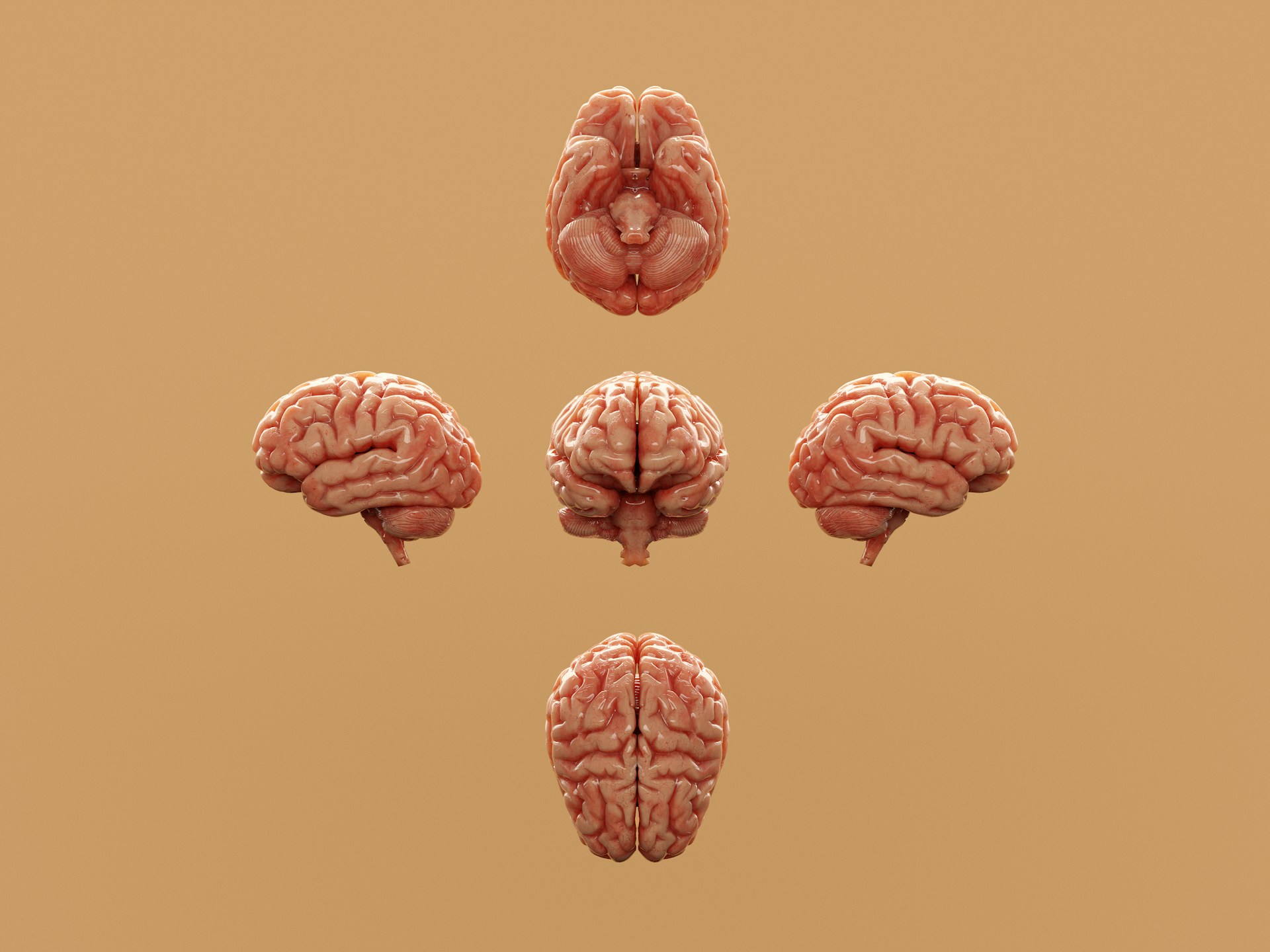
<em><small>Photo by <a href="https://unsplash.com/@aakashdhage?utm_source=unsplash&amp;utm_medium=referral&amp;utm_content=creditCopyText">Aakash Dhage</a> on <a href="https://unsplash.com/photos/various-perspectives-of-a-human-brain-are-displayed-vd-JLio94Wo?utm_source=unsplash&amp;utm_medium=referral&amp;utm_content=creditCopyText">Unsplash</a></small></em></p>

<p>We have different campaigns for different months of the year. One of the most famous ones is <a href="https://no-shave.org/"><em>No-Shave November</em></a>, a fundraising campaign that raises awareness and funds for cancer research. There are many others as well, such as:</p>

<ul>
  <li>Autism Acceptance Month</li>
  <li>Mental Health Awareness Month</li>
  <li>HIV/AIDS Awareness Month</li>
</ul>

<p>Today, I want to propose a new campaign: <strong><em>Dopamine Detox December</em></strong> — a month dedicated to reducing overstimulation and reclaiming attention.</p>

<h2 id="dopamine-matters">Dopamine Matters</h2>

<p>“Dopamine detox” is a popular phrase, but scientifically, dopamine isn’t something we can “flush out” or reduce directly. Dopamine is a neurotransmitter that plays a crucial role in motivation, reward, learning, and habit formation. It is always present in the brain.</p>

<p>The real issue is <strong>chronic overstimulation</strong>.</p>

<p>Modern digital environments — especially social media, fast-paced entertainment, constant notifications, and instant information — repeatedly trigger the brain’s reward system. Over time, this can lead to:</p>

<ul>
  <li>Shorter attention spans</li>
  <li>Lower tolerance for boredom</li>
  <li>Difficulty concentrating on long-form content (books, deep work)</li>
  <li>Habitual checking behavior (scrolling without intention)</li>
  <li>Emotional fatigue and anxiety</li>
</ul>

<p>Research in behavioral psychology and neuroscience suggests that frequent exposure to high-reward stimuli can reduce our sensitivity to lower-reward but meaningful activities (reading, exercising, long-term projects).</p>

<p><strong>Dopamine Detox December</strong> is not about eliminating dopamine. It’s about reducing artificial reward spikes so the brain can rebalance and relearn how to enjoy slower, healthier activities.</p>

<h2 id="how-does-it-work">How does it work?</h2>

<p>During the month of December, we simply stop doing some things and do more of some other things.</p>

<h2 id="what-we-avoid-in-december">What We Avoid in December</h2>

<p>During the month of December, the idea is to reduce or pause the following:</p>

<ul>
  <li><strong>Social media</strong>: uninstall or sign out from all apps.</li>
  <li><strong>News consumption</strong>: uninstall news apps and use browser/OS tools to limit access.</li>
  <li><strong>Streaming content</strong>: limit TV or Netflix to a maximum of 30 minutes per day.</li>
  <li><strong>Highly stimulating music</strong>: avoid energetic, high-dopamine tracks (normal or calm music is fine).</li>
  <li><strong>Audio during walks</strong>: walking in silence improves mindfulness and reduces passive stimulation.</li>
  <li><strong>Alcohol</strong></li>
  <li><strong>Smoking</strong></li>
  <li><strong>Junk food and sugary snacks</strong></li>
</ul>

<p>Each of these behaviors triggers fast, easy, and frequent dopamine responses. Taking a break helps reset your baseline.</p>

<h2 id="what-we-replace-it-with">What We Replace It With</h2>

<p>Instead of passive or highly stimulating consumption, shift your energy toward:</p>

<ul>
  <li><strong>Walking and exercise</strong>: improves mood-regulating neurotransmitters and reduces stress.</li>
  <li><strong>Reading books or listening to audiobooks</strong>: encourages deep focus.</li>
  <li><strong>Helping your partner or family</strong>: builds social bonding and empathy.</li>
  <li><strong>Cooking at home</strong>: especially whole, nutritious foods that stabilize mood and energy.</li>
  <li><strong>Mindfulness or journaling</strong>: reduces cognitive noise and increases clarity.</li>
  <li><strong>Creative activities</strong>: drawing, writing, coding personal projects, DIY, music practice.</li>
</ul>

<p>These activities provide <strong>slower, more stable, and more meaningful dopamine patterns</strong> — the kind linked with long-term well-being.</p>

<h2 id="what-you-can-expect-after-one-month">What You Can Expect After One Month</h2>

<p>After 30 days of reduced overstimulation, many people report:</p>

<ul>
  <li>Improved concentration and ability to stay with tasks</li>
  <li>Lower anxiety and mental clutter</li>
  <li>Better sleep quality</li>
  <li>More enjoyment from simple activities</li>
  <li>Increased patience and emotional stability</li>
  <li>A reduced urge to check phones or apps</li>
  <li>Higher productivity and deeper work sessions</li>
</ul>

<p>By the end of the month, your brain is more attuned to “normal” levels of reward again — which makes life feel calmer, more intentional, and more enjoyable.</p>]]></content><author><name>Mohammad M. Ramezanpour</name></author><category term="productivity" /><summary type="html"><![CDATA[Introducing Dopamine Detox December: a month to reduce overstimulation, reclaim your attention, and learn how dopamine really works.]]></summary><media:thumbnail xmlns:media="http://search.yahoo.com/mrss/" url="https://ramezanpour.net/assets/images/dopamine_brain.jpg" /><media:content medium="image" url="https://ramezanpour.net/assets/images/dopamine_brain.jpg" xmlns:media="http://search.yahoo.com/mrss/" /></entry><entry><title type="html">The Soft Skill Every Manager Needs: Working With Everyone</title><link href="https://ramezanpour.net/post/2025/11/24/be-able-to-work-with-everyone" rel="alternate" type="text/html" title="The Soft Skill Every Manager Needs: Working With Everyone" /><published>2025-11-24T00:00:00+00:00</published><updated>2025-11-24T00:00:00+00:00</updated><id>https://ramezanpour.net/post/2025/11/24/be-able-to-work-with-everyone</id><content type="html" xml:base="https://ramezanpour.net/post/2025/11/24/be-able-to-work-with-everyone"><![CDATA[<p>Technical capabilities are important for any competent engineer or engineering manager. With strong technical skills,
you can solve problems faster and stay on top of complex topics.</p>

<p>But being a manager is ultimately about soft skills: managing humans, resolving conflicts within a team, and providing
growth opportunities.</p>

<p>One soft skill that people often underestimate is the ability to work effectively with different functions — especially
with product managers. A strong engineering manager should not only work well with a highly skilled, experienced PM;
they should also be able to collaborate productively with a junior, inconsistent, or less mature PM.</p>

<p>This adaptability is what separates effective managers from the rest. You don’t get to choose the skill level of your
counterparts, but you can choose how well you work with them.</p>

<p><strong>Cross-functional collaboration</strong> isn’t just a nice-to-have. It’s a core leadership skill. The more you can adapt your
communication, expectations, and style to any product manager — regardless of their strengths or weaknesses — the more
effective and productive your team will be.</p>]]></content><author><name>Mohammad M. Ramezanpour</name></author><category term="Management" /><summary type="html"><![CDATA[Why the ability to work with everyone, especially product managers, is the underrated soft skill every engineering manager needs.]]></summary></entry></feed>